 ShipStamp
Vinted vs eBay Shipping: Which Is Cheaper for Sellers?
It’s the question every UK reseller asks eventually: am I losing money shipping on the wrong platform? The answer isn’t a single number. Vinted and eBay handle postage in fundamentally different ways, and the cheaper option flips depending on what you’re selling and for how much. Here’s how the two actually compare, without the spin.
The key difference: who pays the postage
Start here, because it’s where most confusion comes from. On Vinted and on eBay, postage sits in completely different places.
On Vinted, the buyer pays for postage. When someone buys your item, they pick a courier at checkout from the options you’ve enabled and pay that cost on top of the item price. As the seller, you don’t pay postage at all. You just print the label Vinted gives you and send the parcel. Vinted also charges sellers no selling fee — the “Buyer Protection” fee is paid by the buyer.
On eBay, it’s the seller’s call. You either offer free postage, in which case you build the cost into your asking price and absorb it, or you charge postage to the buyer as a separate line. Either way you’re the one buying the label. eBay then takes a final value fee, calculated as a percentage of the total the buyer pays — and that total usually includes the postage.
That last detail catches people out. On eBay, you can end up paying a fee on the postage you charged.
So which is cheaper? It depends entirely on what you sell
There’s no universal winner, and anyone who tells you otherwise is selling something. The maths swings on the value and type of the item.
Cheap clothing — Vinted usually wins. A £6 top is the classic Vinted sale. No seller fee, buyer pays postage, you keep close to the full £6. On eBay, the final value fee plus the postage economics eat into a low-value sale fast. For bulk wardrobe clearouts, Vinted is hard to beat on cost.
Higher-value or branded items — eBay often wins. Sell a £120 pair of trainers and eBay’s far larger, search-driven marketplace tends to find a buyer willing to pay more. The final value fee is a percentage, yes, but a higher sale price on eBay frequently nets more than a lower one on Vinted, even after fees.
Anything that isn’t clothing — eBay, by default. Vinted is built around fashion and a narrow set of adjacent categories. Electronics, homeware, collectables, parts: that’s eBay’s territory. The shipping comparison barely matters if one platform won’t list your item in the first place.
The postage cost itself is roughly the same
One thing that surprises sellers: the actual cost of moving a parcel is similar on both. Both platforms route through the same UK couriers — Evri, InPost, Yodel, Royal Mail — at broadly comparable negotiated rates. A small parcel costs about what a small parcel costs, whoever sold it.
The difference isn’t the postage price. It’s who carries that cost and how the platform’s fees stack on top. That’s why the “cheaper” platform is really a question about fees and sale price, not about shipping rates.
The cost nobody puts in the spreadsheet: your time
Here’s the part the fee comparisons ignore. If you sell on both — and plenty of serious resellers do, because the platforms suit different stock — there’s a hidden cost that never shows up in either platform’s fee breakdown. Your time handling two separate label systems.
Vinted emails you a label one way. eBay produces labels another way, through its own postage system. Two inboxes to watch, two formats, two routines. On a busy week you’re hopping between platforms, downloading PDFs, working out which sale goes with which label, and printing them one at a time. That time is a real cost. It just never lands on a fees page.
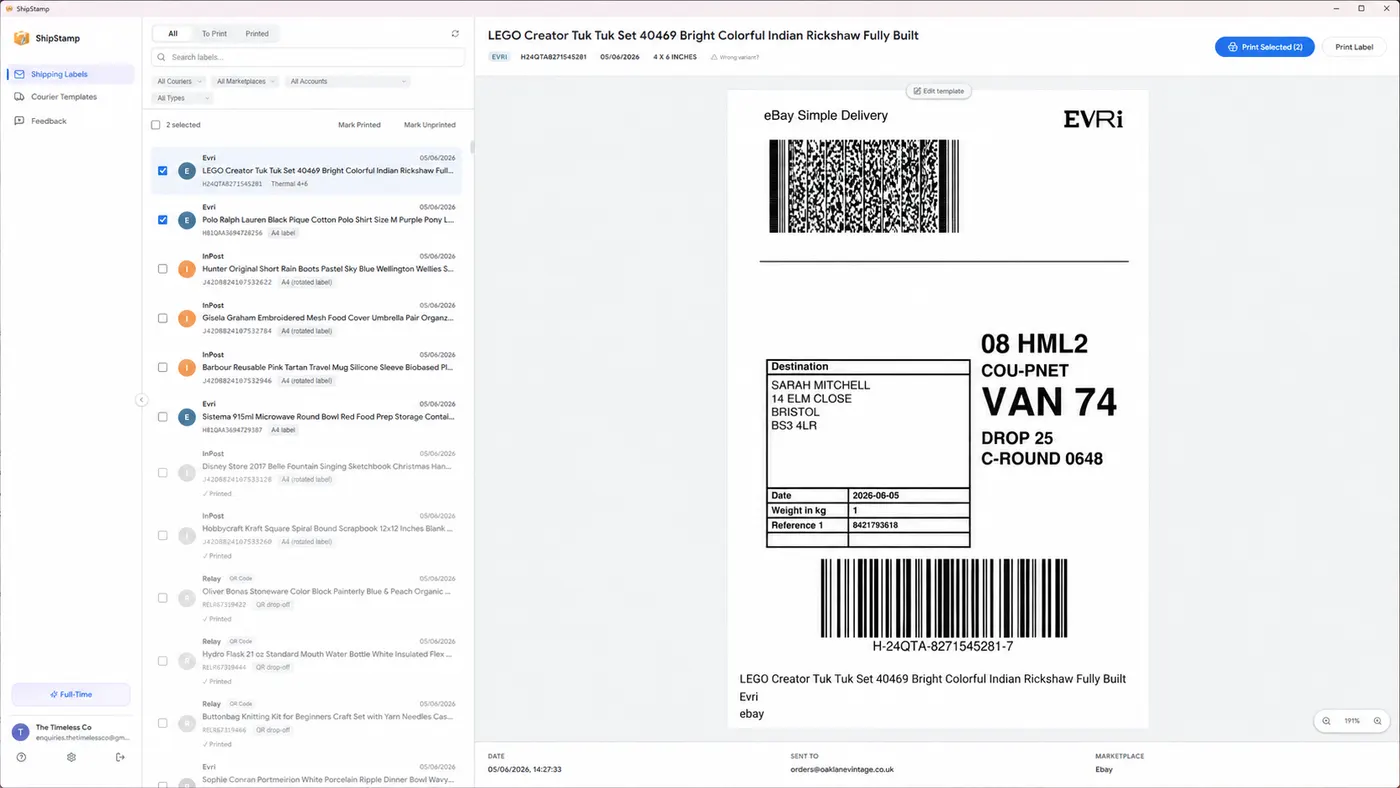
For a seller doing twenty or thirty parcels a week across both platforms, this overhead adds up to hours a month. It’s the cost that quietly decides whether selling on two platforms feels worth it or just feels like twice the admin.
The practical answer
Sell cheap clothing? Lead with Vinted. Sell higher-value items, branded goods, or anything outside fashion? eBay will usually serve you better even after its fees. Most people who do this seriously end up on both, using each for what it’s good at.
And once you’re on both, the postage-cost question matters less than the workflow question. Sort out how you get every label — from either platform — printed quickly, and the “which is cheaper” debate shrinks to what it really is: a per-item decision, not a reason to abandon one platform.
Common questions
Who pays for postage on Vinted?
The buyer pays the shipping cost, chosen at checkout from the courier options the seller has enabled. The seller doesn’t pay postage out of the sale price. The seller does print and attach the label, which Vinted provides.
Who pays for postage on eBay?
It depends on the listing. The seller sets postage as either free (built into the item price) or charged to the buyer. If postage is free, the seller absorbs it. Either way the seller buys and prints the label, often through eBay’s own discounted postage labels.
Is Vinted or eBay cheaper for sellers?
It depends on what you sell. Vinted charges sellers no selling fee and the buyer pays postage, which suits low-value clothing. eBay charges a final value fee but reaches a far larger market and supports higher-value and non-clothing items. For cheap clothes Vinted is usually cheaper to sell on; for valuable or niche items eBay often nets more even after fees.
The fix
Sell on both? Print from both, in one place
ShipStamp connects to your Gmail or Outlook inbox and finds every shipping label automatically — Vinted and eBay, every courier — then groups them together so you’re not flipping between two platforms to work out what needs printing. One list, one click, one printer.
It sizes each courier’s label correctly, remembers the settings per courier, and works with any printer Windows can see. The time cost of running two platforms — the one that never shows up in the fee comparison — is the thing it removes.
Free to try. 50 labels included, no card required.
Join the waitlist