 ShipStamp
Nobody Has Built the Obvious App for Multi-Platform Sellers. Here’s Why That’s Stranger Than It Sounds.
Hundreds of thousands of UK sellers list simultaneously on eBay and Vinted. Every sale generates a shipping label. Every one of those labels arrives in a different place, in a different format, via a different workflow. In 2026, there is still no mainstream tool that simply collects them all in one place and lets you print them. This is the story of a gap so obvious it should have been filled years ago, and why it wasn’t.
The multi-platform seller is the norm, not the exception
Ask any serious UK reseller where they list their items and the answer is almost never a single platform. It’s almost always some combination. eBay for electronics, collectibles, and branded goods where buyers search with intent. Vinted for clothing, shoes, and accessories where the audience skews younger and the fees are lower. Some sellers add Depop, Shpock, or Facebook Marketplace on top. The platforms serve different audiences and different categories, and experienced sellers have long since learned to play them off each other.
This isn’t a niche behaviour. According to various surveys of UK resellers, the majority of people who sell on Vinted also sell, or have sold, on eBay. The crossover is so common as to be unremarkable. Mention it in any secondhand selling community and you’ll get nods of recognition, not surprise.
Yet the moment a sale is made on either platform, a problem emerges. Not a catastrophic problem. Not a deal-breaking one. Just the kind of low-grade, persistent, daily friction that compounds invisibly over time and makes a side hustle feel more like admin work than it needs to.
The problem is labels.
What actually happens when you sell on both
Here is a realistic Tuesday morning for a seller who moves thirty to fifty items a month across both platforms. They wake up to notifications. Three Vinted sales overnight. Two eBay sales. One sale on Depop from a listing they’d half-forgotten was live.
The Vinted labels are in their Gmail inbox, buried between promotional emails and a newsletter. Each one requires opening the email, finding the PDF attachment or link, downloading it, and printing it (with all of the label-sizing issues that Vinted’s A4-formatted PDFs create for thermal printer users (a problem covered in depth in our thermal printer guide).
The eBay labels are in a different place entirely. eBay’s label workflow lives inside the platform itself: you go to “Orders”, find each sale, click through to print the label, choose your carrier options, and generate the PDF. Some sellers have eBay notifications going to a different email address from their Vinted account, because their eBay registration predates their Vinted one by years. Now they’re managing two inboxes.
The Depop sale? That label arrives via email too, but in yet another format, via yet another courier integration. Depop has historically used a mix of Evri and Royal Mail depending on parcel size, and the label generation flow has changed enough times that sellers sometimes aren’t sure which workflow applies to which sale until they’re standing at a drop-off point with the wrong label.
Now add the physical reality. The seller has a thermal label printer. They want to print everything in sequence and get the parcels ready in one session. To do that with the current state of tooling, they must context-switch between three different platforms, two email inboxes, and at least two different PDF applications. Each switch is a small interruption. Each interruption is a small opportunity for an error: a label skipped, a parcel mislabelled, an order that gets missed and generates a late-dispatch warning.
The gap that should not exist
The strange thing is not that this problem exists. Software gaps exist everywhere, and the secondhand selling market, for all its scale, is not the most glamorous target for developers. The strange thing is how long it has persisted without anyone building the obvious fix.
Think about what the solution would look like. You connect your email accounts: Gmail, Outlook, wherever your sale notifications land. The tool monitors those accounts, detects incoming shipping label emails from eBay, Vinted, and other platforms, extracts the label, and surfaces it in a single unified queue. You open the tool in the morning, see every label from every platform waiting for you, and print them all in one session. Done.
This isn’t a technically exotic idea. Email parsing is a solved problem. PDF extraction is a solved problem. Printer integration is a solved problem. The component parts have been commoditised for years. Yet the assembled product (a simple, unified label queue for multi-platform resellers) doesn’t exist in any mainstream form.
Why not? A few reasons, each of which individually makes sense but collectively creates a gap that has persisted long past when it should have been filled.
Why the big platforms have no interest in solving it
The first and most important reason is that eBay, Vinted, and the other marketplaces have no commercial incentive to make cross-platform label management easier. On the contrary: the more friction there is in switching between platforms, the more each platform captures the seller’s attention during their selling session. A seller who must open eBay to print their eBay labels is a seller who is browsing eBay. That’s not an accident. Platform stickiness is a design goal, not a side effect.
eBay in particular has invested heavily in its seller hub, a comprehensive dashboard covering listings, orders, performance, and labels, precisely because keeping sellers inside eBay’s own ecosystem is strategically valuable. The last thing eBay wants is a third-party tool that abstracts away the label workflow and reduces eBay to a sales channel the seller never needs to log into.
Vinted is arguably worse. Its label flow is deliberately minimal: a link in an email, a PDF download, because Vinted’s product philosophy has consistently prioritised simplicity for casual sellers over power features for professionals. The platform is designed for someone selling five items from their wardrobe, not someone running a fifty-item-a-month reselling operation. The power sellers who would most benefit from better tooling are not Vinted’s target user.
Why third-party tools have not filled the gap
The second reason is the email problem. Accessing a user’s inbox, even read-only, even for a clearly beneficial purpose, requires OAuth integration with Google and Microsoft, both of which operate lengthy and expensive application review processes. Google’s Gmail API verification, in particular, requires a formal security assessment for any app that requests access to user email. That assessment costs thousands of pounds and takes months to complete. For a small developer building a niche tool for secondhand sellers, this is a prohibitive barrier. Most such projects never make it past the idea stage.
The ones that have tried a different approach, such as scraping eBay’s seller hub, say, or polling Vinted’s web interface, run immediately into terms-of-service issues. Both platforms explicitly prohibit unauthorised scraping. Developers who build tools this way do so at constant risk of having their access revoked, their users locked out, and potentially facing legal action. It’s a precarious foundation for any serious product.
There are also, frankly, relatively few developers who are themselves active resellers. The people who most acutely feel the pain of fragmented label workflows are not typically the people who build software for a living. And the people who build software for a living don’t typically spend their evenings selling vintage jackets on Vinted. The problem and the skillset to solve it rarely coexist.
What sellers do instead
In the absence of a proper solution, sellers have developed workarounds that function adequately but represent a significant collective waste of time.
The most common is a dedicated email folder system. One folder per platform, with filters that automatically sort incoming label emails. This doesn’t unify the labels: you still have to open each email individually and download each PDF, but at least they’re in one place rather than mixed into a general inbox. It’s the kind of marginal improvement that feels like progress until you realise you’re still opening twelve emails on a busy morning.
Some sellers use a dedicated selling email address, a Gmail account that exists solely to receive platform notifications, and process it in a dedicated browser tab during their packing session. More disciplined than the folder approach, but it still requires opening each email, downloading each PDF, and managing each print individually.
Power sellers who have reached sufficient volume sometimes hire a virtual assistant to handle fulfilment admin, including label printing. This solves the time problem by outsourcing it, but it introduces coordination overhead and a per-hour cost that eats into margins. It also only scales to sellers with the revenue to justify it.
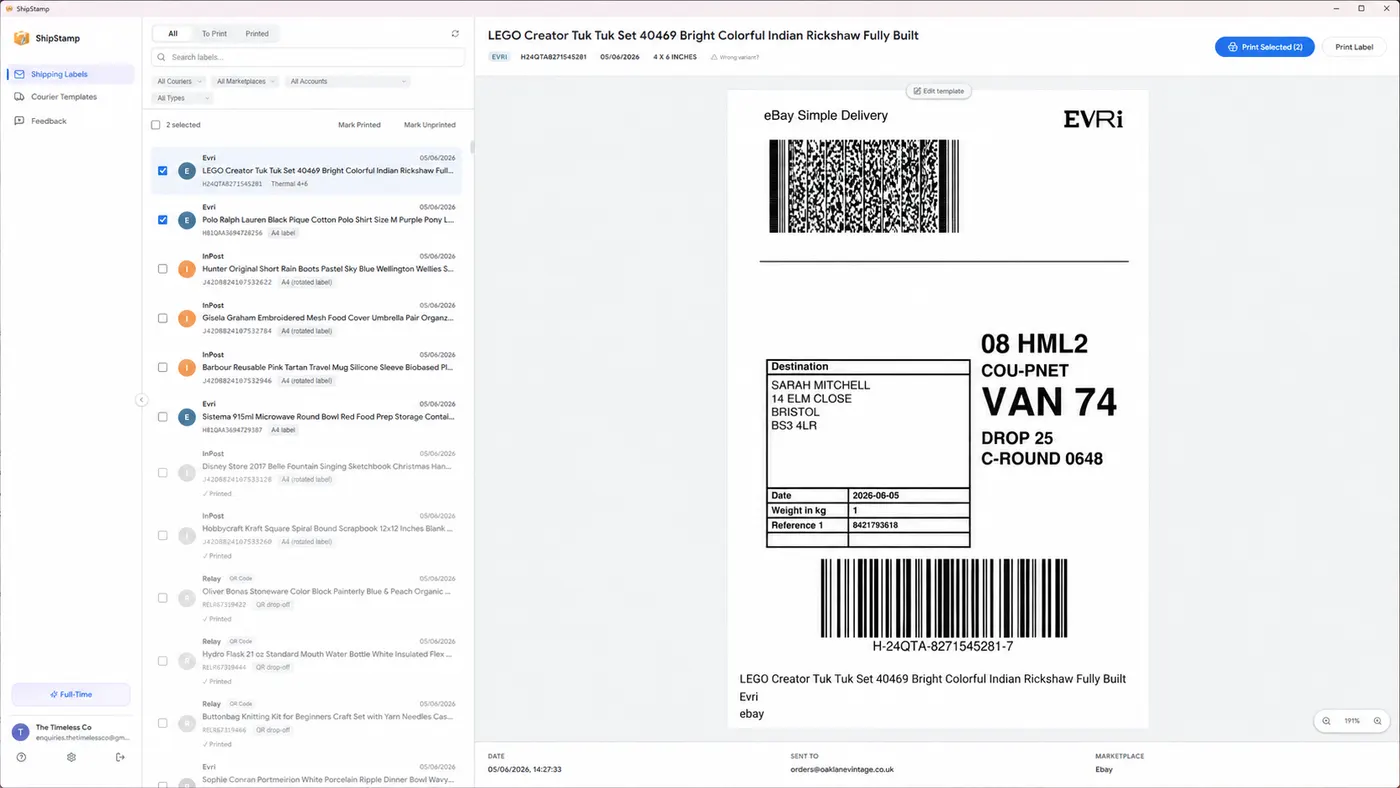
What nobody has, because it doesn’t exist, is a single dashboard that shows every unprinted label from every platform, sorted by courier, ready to print in sequence.
The cost, measured honestly
Sellers tend to absorb this friction without accounting for it. So let’s put a number on it.
A seller who manages ten sales a day across two platforms, spending four minutes per sale on label retrieval and printing, is spending forty minutes a day on this task. Over a week, that’s just under five hours. Over a year, it’s approaching two hundred and fifty hours, the equivalent of more than six full working weeks spent doing nothing but finding, downloading, and printing labels that should arrive automatically in a queue.
That calculation will feel familiar to any seller who has sat down and actually thought about where their packing time goes. The individual sessions feel brief. The aggregate is staggering.
Then there’s the cognitive cost. Switching between platforms mid-session isn’t just a time cost, but an attention cost. Every context switch creates an opportunity for an error: a label missed, an order processed twice, a parcel sent to the wrong address because two very similar orders arrived on the same afternoon and the seller was half-watching a YouTube video whilst they packed. These errors are rare. But they’re not zero, and their consequences (refunds, negative feedback, courier disputes) are disproportionately damaging for a small seller’s reputation.
The seller who falls through every gap
There is a particular type of UK seller who has been poorly served by every platform and every tool in this space for the better part of a decade: the semi-professional reseller. Not a registered business, but not a casual wardrobe-clearout either. Someone who sells twenty to a hundred items a month, treats it as a meaningful side income or a part-time occupation, and has invested in the infrastructure (thermal printer, packing supplies, collection point account) to do it efficiently.
The platforms treat this person as a power user for fee purposes but as a casual user for tooling purposes. The enterprise-grade shipping integrations that large eBay businesses use, tools that connect warehouse management systems to carrier APIs, are overkill, expensive, and designed for companies processing hundreds of orders a day, not individuals processing dozens. The consumer-grade experience the platforms offer natively is designed for someone selling five items a season.
The semi-professional reseller sits in the middle, underserved by both ends of the market, improvising workflows from a combination of email filters, downloaded PDFs, and tribal knowledge picked up from Reddit threads.
Common questions
Is there an app that combines eBay and Vinted labels in one place?
Yes. ShipStamp connects to your Gmail or Outlook inbox and pulls shipping labels from both eBay and Vinted automatically, displaying them in a single queue grouped by courier, ready to print in one click.
Why don’t eBay and Vinted share a label workflow?
eBay stores labels inside its own platform (you generate them in your seller hub), while Vinted emails them as PDF attachments. The two systems are completely different, and neither platform has an incentive to help sellers work across both.
How do I print labels from eBay and Vinted in one session?
Use ShipStamp, which monitors your Gmail or Outlook inbox, automatically detects label emails from Vinted and eBay, and lets you print everything from one dashboard — sorted by courier, in one click.
The fix
ShipStamp is the unified label dashboard that should have existed years ago
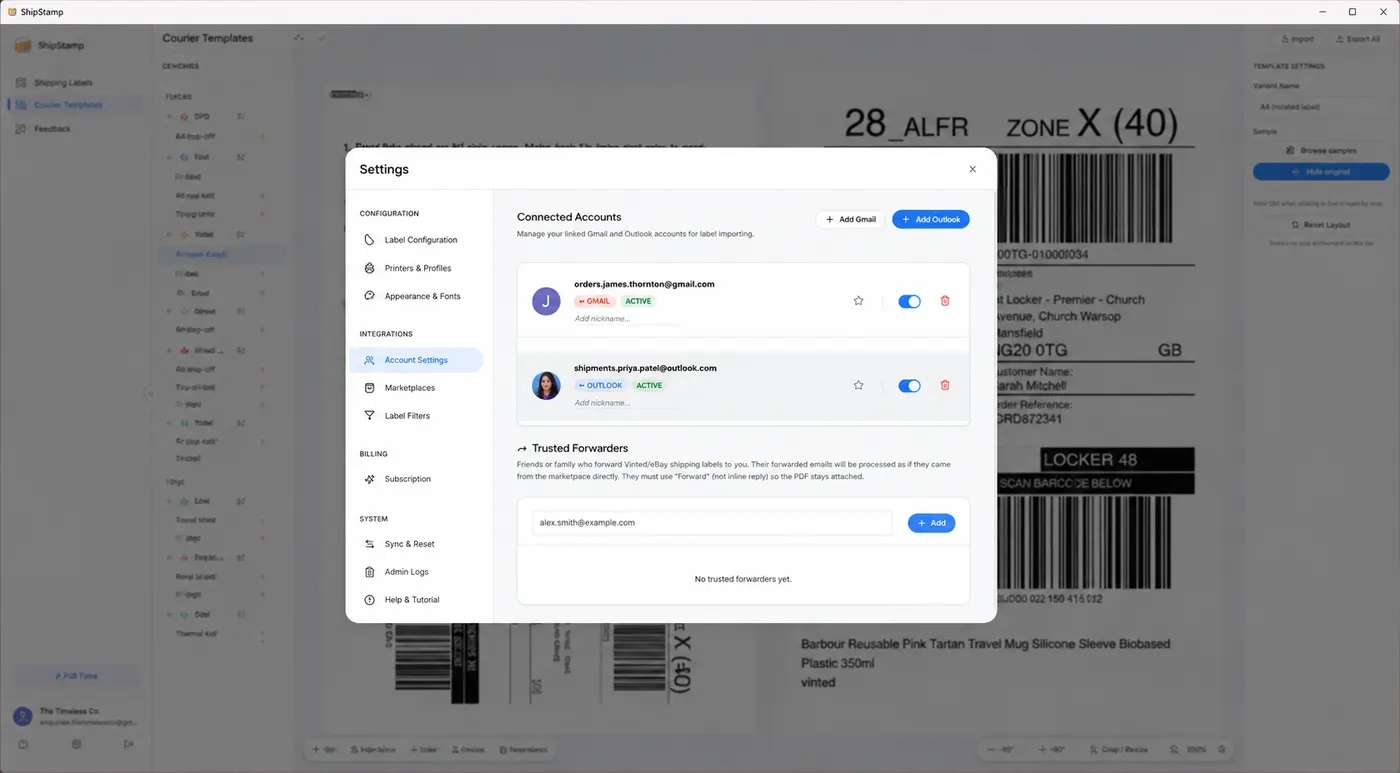
ShipStamp connects to your Gmail or Outlook inbox, the same accounts your Vinted and eBay sale notifications already land in, and monitors them automatically. Every time a new shipping label arrives, from either platform, ShipStamp detects it, extracts the label, identifies the courier, and adds it to your queue.
You open ShipStamp in the morning and see every label from every platform, sorted by courier, ready to print. One click sends them all to your thermal printer, correctly sized at 100×150mm, with proper barcodes, in sequence. No downloading. No platform switching. No print dialog archaeology. Just a clean queue that empties as you pack.
It runs entirely on your Windows PC. Your emails are read on your machine and never leave it. There’s no subscription required to get started. For the semi-professional reseller who’s been improvising their label workflow for years, it’s the tool that should have been built a long time ago.
Join the waitlist